The Decision Review System lets players ask for an on field decision to be checked by the third umpire using replays, ball tracking and audio. It is not a second opinion on every decision and it is not unlimited. Knowing what it can and cannot do explains most of the arguments about it.
How many reviews a side gets
| Format | Unsuccessful reviews per innings |
|---|---|
| Test match | Three |
| One Day International | Two |
| Twenty20 International | Two |
The word that matters there is unsuccessful. A review only counts against the allowance if the original decision survives. If the third umpire overturns the call, the side keeps the review and can use it again.
These numbers went up during the pandemic period, when travel restrictions meant less experienced local umpires were often standing instead of the neutral elite panel. Tests moved from two to three and the white ball formats from one to two, and the higher allowances were kept afterwards.
What can be reviewed, and by whom
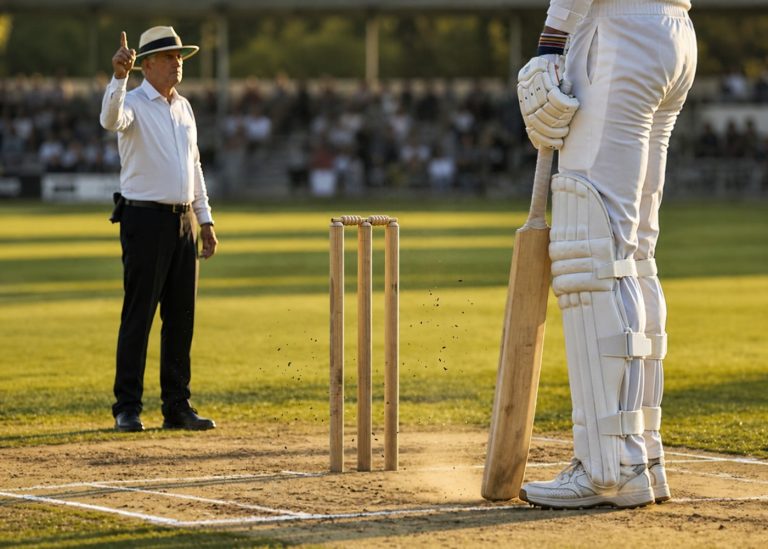
Player reviews cover dismissals only. A fielding side can review a not out decision and a batting side can review an out decision. The request must come from the captain for the fielding side or the batter concerned, and it has to be made within fifteen seconds of the umpire’s decision, signalled with a T made with both arms.
Separately, the on field umpires can refer certain things to the third umpire themselves without it costing anyone a review. Run outs, stumpings, boundary calls and whether a catch carried are all umpire referrals rather than player reviews. No ball checks on every delivery that produces a wicket are also automatic.
What the third umpire looks at, in order
- Was it a legal delivery? A front foot no ball ends the matter.
- Is there an edge? Slow motion replays plus the audio trace, usually a real time snickometer or hot spot where available.
- For LBW, where did it pitch? Ball tracking gives the pitching point.
- Where did it strike the pad? Tracking again, measured against the line of the stumps.
- Would it have hit the stumps? A predicted path onward from the point of impact.
Umpire’s call, the part everyone argues about
Ball tracking is a prediction, not a measurement, and the system treats it that way. For each of the three LBW measurements there is a margin. More than half the ball must be in line with the stumps for pitching and impact. For wickets hitting, the centre of the ball must strike a zone inside the outer edge of the stumps and below the top of the bails.
When a measurement falls inside the margin, the result is umpire’s call: the on field decision stands and the reviewing side keeps its review. This is why two identical looking deliveries can produce opposite outcomes. The system is not deciding what happened, it is deciding whether the evidence is strong enough to overturn a human being.
The common misunderstandings
- A review is not an appeal. You cannot review a decision that was never given, because the umpire has to have made a call first.
- Umpire’s call does not cost a review. It has not since 2017.
- DRS is not used everywhere. In bilateral series its use is agreed between the two boards, so the technology available varies.
- Not every tool is always present. Hot spot in particular is expensive and is often absent, leaving audio and visual evidence only.
- Reviews do not carry over. The allowance resets at the start of each innings.
The honest summary is that DRS was built to remove the howler, not to make every decision perfect. Measured against that goal it works. Measured against the expectation that technology should settle every close call outright, it never will, because the margins are built in on purpose.